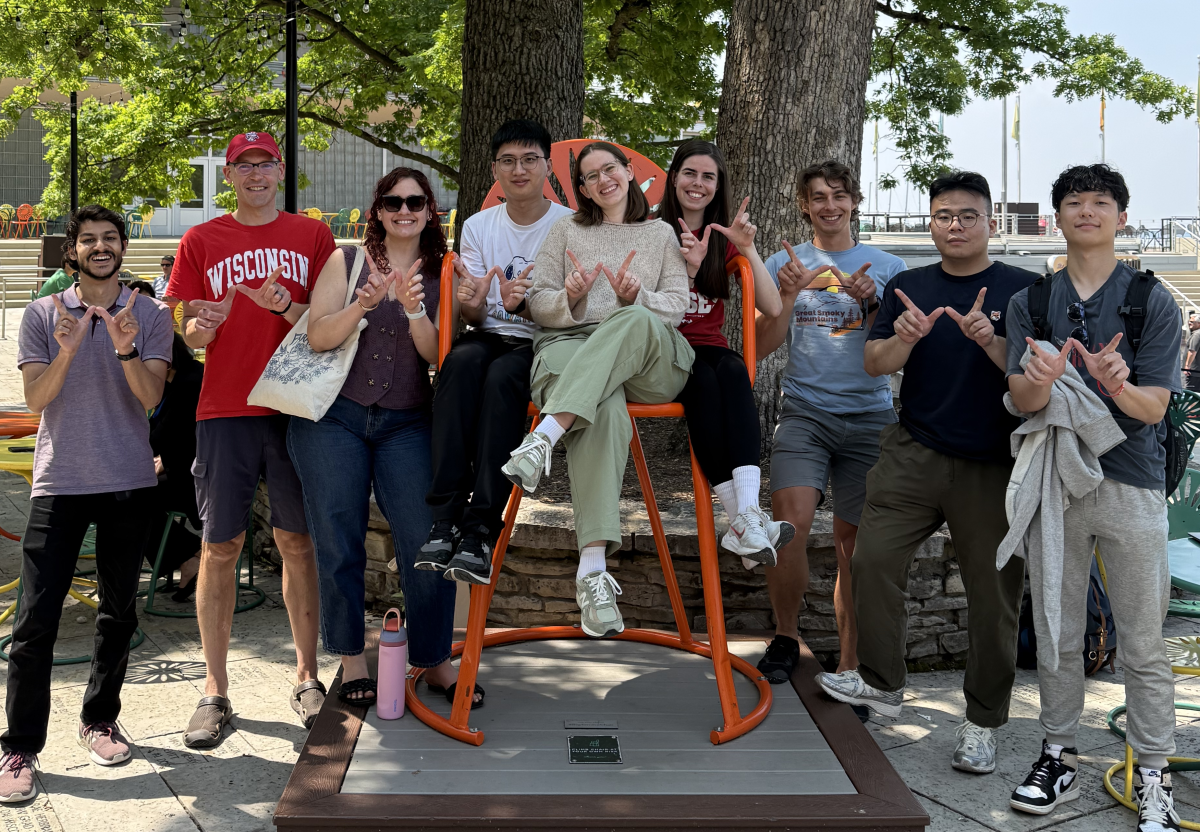
It was a remarkable summer of milestones at the UW BADGER Lab!
In May, Katherine Heidi Fehr, PhD defended her dissertation, titled “Enriching the Evaluation of Mobility Interventions in the Real World”. Heidi did lots of amazing work during her time at UW-Madison, focusing on using wearable sensors to glean more detailed information about movement in real-world environments. Heidi’s definitive work focused on reconstructing detailed foot movement using IMU-based motion reconstruction, and her earlier work used embedded sensors in prostheses to understand how to control semi-active prostheses. Heidi is now a biomechanics researcher at Exponent in California.
Also in May, Rebecca Roembke, PhD defended her dissertation, titled “Possible Solutions to Mobility Challenges Through Understanding of Ankle Mechanics – Exploring Moments at the Ankle and Socket of Transtibial Amputees on Level Ground and Slope With a Two-Axis aDaptable Ankle”. Becca did a fantastic job designing multiple generations of the “TADA”, which controls ankle angle in both sagittal and frontal planes, culminating in a study of walking on sagittal and frontal-plane slopes. She also completed a great study on how leaning your trunk forward and backward alters walking, and contributed to two studies using tendon tensiometry in real-world walking. Becca is now working on insoles for diabetes and more, nearby in Milwaukee, Wisconsin.
In June, Yisen Wang, PhD defended his dissertation, titled “Lower Limb Motion Reconstruction and Mobility Evaluation in Everyday Locomotion”. Yisen dug deep into the mathematical underpinnings of motion reconstruction from foot-based IMUs, including groundbreaking new methods for improving height-reconstruction accuracy and terrain classification, and new ways of understanding turns during locomotion. Yisen also designed and deployed wearable sensor suites for studies in prosthetics, and managed and processed data from many person-months of unsupervised, everyday data in two clinical populations. Yisen is starting his career as a research scientist at a technology company in Shanghai.
In July, Stephanie Beth Hernández Hernández, PhD defended her dissertation, titled “Understanding Motor Learning Principles in the Lower Limbs Using a Haptic Robot (NOTTABIKE)”. Stephanie designed, executed, and analyzed a rich and creative series of studies exploring how principles of motor learning apply to goal-directed movements of the lower-limb. Stephanie especially focused on methods for using reinforcement learning to drive learning, retention, and transfer, including both traditional audio-visual feedback and a novel effort-based feedback paradigm. She enrolled over 100 participants in different protocols! Stephanie began her career at Exponent in Florida.
All these graduates’ great work, and the published and forthcoming papers from it, was possible thanks to the rich and collaborative environment at UW-Madison Mechanical Engineering. On, Wisconsin!